


Coffee Roaster Management System
Background
Coffee is loved worldwide, and the coffee industry is constantly innovating. New roasting technologies and advanced roasters are revolutionizing how beans are crafted to perfection.
In this case, we built a control system for a convection roaster utilizing fluid bed roasting technology.
The system runs without any mechanical drums or mixers. Instead, it uses a hot air stream from below to evenly roast coffee beans, producing a dynamic "boiling" effect. This ensures no chaff, smoke, or burnt beans in the output.

Request
Our client produces coffee roasters that use the innovative fluid bed roasting technology. Their range spans from small-scale models to heavy-duty industrial machines capable of roasting tens of kilograms per hour. They engaged Integra Sources to build a comprehensive hardware and software automation platform to control all these models. A critical requirement was ensuring the system could interface smoothly with third-party software already in use by some operators.
By automating the roasting workflow, operators no longer need to manually supervise every step, which allows them to manage multiple machines concurrently and handle other responsibilities. This automation also minimizes human error, enhancing process reliability.
The system should monitor ambient humidity and temperature, as well as the moisture level of the coffee beans, automatically adjusting roasting parameters to maintain optimal quality under varying conditions. With an intuitive UI and wide-ranging compatibility, this automation platform delivers a clear competitive advantage.
Solution
We started building the roster management system by deeply analyzing the client’s needs and conducting market research to identify existing solutions and areas for improvement. Based on these insights, we created the technical specs and finalized every detail with the client.
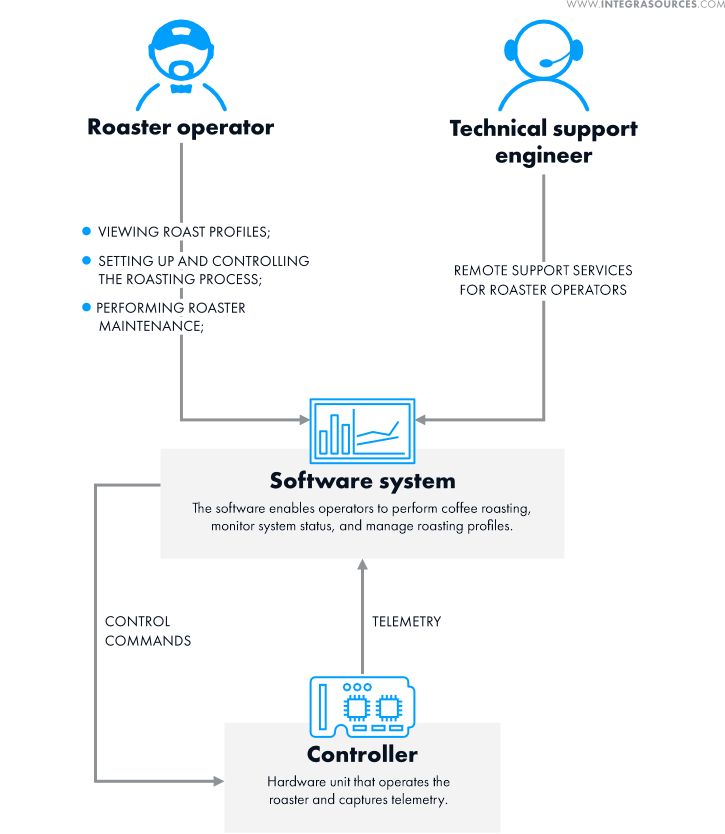
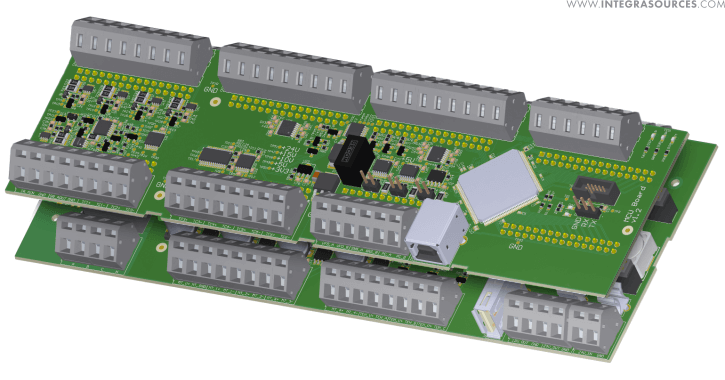
At the heart of the system is a controller built by Integra’s engineering team. The PCB pulls in data from a range of sensors—humidity, air temp, bean temp, and hatch positions. In industrial models, it also gathers input from weight sensors. The board processes all this data and issues the necessary commands.
We connected the controller to a Raspberry Pi single-board computer running Ubuntu, which takes care of the user interface.
To handle data transfer to the Raspberry Pi, we integrated two interfaces: USB and RS-485. USB is the standard, speedy option, but it can be unreliable in electrically noisy environments. That’s why we made it possible to switch to RS-485—an interface that’s a bit slower but much more resilient to interference and is widely used in industrial environments. RS-485 is also employed for sensor connectivity.
We built the software from scratch. It handles the whole roasting process, keeps track of system status, and analyzes the data. The 13-inch touchscreen lets users set roast profiles, tweak settings like temperature and fan power, check out temperature charts, and create custom roast profiles. Our engineers crafted the entire UI—all buttons, screens, and interactive elements.
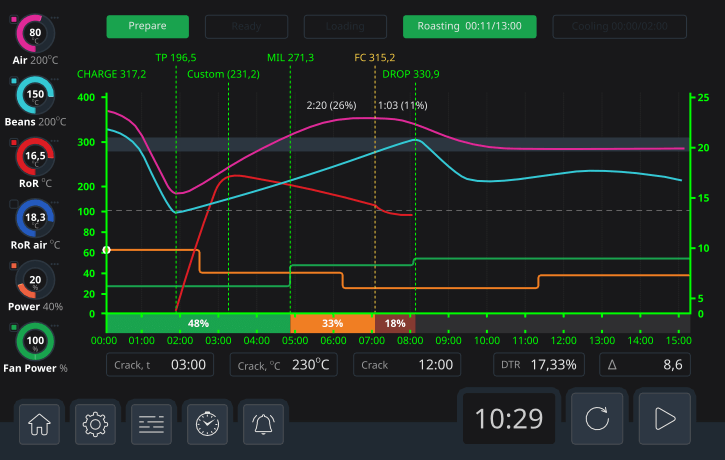
We developed two ways to automate roasting in our solution. The first repeats a predefined roasting profile, where every step is scheduled by time and temperature. The second method uses checkpoints that users can add and associate with specific triggers—for example, loading coffee or reaching the desired temperature. This mode offers adaptive control, allowing the system to respond to real conditions like fluctuations in bean moisture levels.
Alongside automatic control, the solution also supports manual mode. A large red emergency stop button ensures immediate process termination for safety.
Our team also added the option for all users to browse and copy the finest roast profiles. To speed up support and diagnostics, we rolled out remote access through RustDesk.
At the client’s request, we integrated compatibility with third-party software, so users accustomed to alternative programs can easily work with the customer’s roster system.
Competitive Advantages
OTA Firmware Updates
Our team implemented OTA firmware updates that let us quickly fix bugs and add new features without recalling devices.
Roasters automatically detect, download, and install updates, minimizing costs and downtime. This ensures customers always have the latest product version, while we gain the ability to swiftly enhance quality.
All-in-One Board
Both the controller and the software were developed to cover a wide range of roaster models and support advanced features for the top-tier models. For simpler versions, certain components are left off the board, which streamlines manufacturing and reduces the overall component costs.
Third-Party Software Support
Some roster users prefer working with their go-to programs and don’t want to migrate to new software, despite its expanded feature set. In these cases, the controller provides seamless integration with third-party software.
Customizable Roasting Profiles
Our checkpoint-driven roasting mode responds to specific events—like hitting a target temperature or the first crack of the coffee beans. Since raw material parameters and environmental factors such as humidity and ambient temperature can fluctuate, leveraging checkpoints allows us to dynamically adjust for these variables. We extended the platform to let users add custom checkpoints to the roasting curve, making it easier to replicate precise roasting profiles.
Major Issues Resolved
Temperature Sensors
During operation, the temperature sensor began delivering inaccurate readings. The problem was traced back to the IC that translates sensor signals into temperature data and sends it to the MCU.
Due to the customer's use of long, unshielded thermocouple wires, the IC picked up interference from a nearby frequency converter. The chip interpreted noise as high voltage and locked up. We fixed this by adding an RC filter to block the noise.
Frequency Converter
The roaster uses a frequency changer to adjust the hot air flow speed. Although the client initially specified one device, a different model was actually implemented. We had to refactor the codebase and redesign the communication protocol to accommodate the new frequency converter.
Precise Phase Control
To control the high-power heaters in the industrial roasters, we selected solid-state relays (SSRs). To minimize electromagnetic interference and extend relay lifespan, we implemented zero-cross switching—turning the relays on and off precisely when the AC voltage crosses zero. This approach reduces stress on the relays and lowers noise on the power line. Instead of costly SSRs with built-in zero-cross detection, we opted for standard SSRs, which reduced costs and improved interchangeability.
Implementing zero-cross detection required minimal latency and immediate response to voltage changes. In a typical situation, we would have used optocouplers, but to generate the necessary current in the optocoupler's LED, the sinusoidal voltage must rise slightly after crossing zero. This process takes time, which also varies depending on different factors, resulting in unpredictable delays. So, instead of standard optocouplers, our engineer used voltage comparators that detect the sinusoidal zero-cross within tens of microseconds. This approach delivers enhanced system stability and accurate triggering, essential for robust heater control.
Our developers also integrated a load balancing algorithm that evenly distributes switching events, reducing noise and preventing heater overheating. All in all, it makes the system run better and more reliably.
Scope of Work
- Schematic and PCB design;
- PCB assembly, testing, and fixing;
- Firmware development;
- Linux app development.
Technologies
- Altium Designer for schematics and PCB design.
- The system runs on a Raspberry Pi 4 SBC, interfacing through RS-485 (MODBUS RTU) or USB.
- GD32F427ZGT6 MCU, powered by the Arm® Cortex®-M4 core with a processor frequency of up to 200 MHz.
- The software stack includes QT Creator as the IDE, Qt framework, and C++/QML for building a Linux (Ubuntu 22) app.
- TeamViewer IoT Agent library provides remote access capabilities.
- Custom firmware created with C++, VS Code IDE, CMake cross-platform tool, GitLab, and the GCC compiler.
- SQLite is used for structured data storage.
- UART is used for sending control commands and receiving telemetry.
- ProtoBuf protocol for data serialization.
- Display—a 13'' full-color screen.
Result
Automation & Usability
Our all-in-one, robust roaster management system is engineered to meet the highest market standards. Automating the roasting process frees operators from manual mode switching, reducing errors and accelerating training cycles.
Cost-Efficient Support
By leveraging OTA firmware updates, we cut down on service and support costs by fixing bugs and adding new features quickly—no need to send devices back to the shop. This saves time and money for manufacturers and ensures users enjoy hassle-free, stable device performance.
With remote access, support engineers can troubleshoot and configure devices in real-time, see problems firsthand, and deliver precise recommendations. It makes support easier and builds stronger trust in the brand.
Scalability & Optimization
Our universal board works with different roaster models, and we optimized the hardware by using one ADC with a multiplexer for six thermocouples. That keeps costs down and simplifies scaling.
Flexibility & Integration
The custom roasting mode lets operators add checkpoints that adapt to changes in beans and environment, enabling precise profile replication. Additionally, our controller supports third-party software integration, providing users the flexibility to work with familiar applications.
By implementing our automated, scalable system with adaptive controls and third-party software support, the client can lower costs, achieve more stable roasting operations, and strengthen their brand presence in the market.
You might also like...

Firmware Development for Augmented Reality Glasses
The team improved the customer’s firmware for augmented reality glasses by developing drivers for the displays, accelerometer, and gyroscope of the device. 
LEARN MORE 

Software for EEG System
The Integra Sources team developed energy-efficient embedded software and an SDK for a medical EEG system. We delivered robust data transfer and storage, implemented multitasking on FreeRTOS, and improved connection security.
LEARN MORE