


Custom Continuous Glucose Monitoring System Development
Background
Unfortunately, the number of people suffering from diabetes worldwide is continuously rising. When using traditional blood glucose meters, patients have to prick their finger several times a day. It causes pain and inconvenience. The advantage of continuous glucose monitoring (CGM) systems is that they allow real-time tracking of blood sugar levels without pain.
A CGM system is a small, waterproof sensor attached to the body. It measures glucose levels in the interstitial fluid every few minutes and transmits the data to a smartphone.
Continuous monitoring significantly improves the quality of life for individuals with diabetes. The system eliminates the need for regular, painful procedures and automatically alerts the user to a critical drop or spike in glucose levels before they feel unwell.

A manufacturer of medical and laboratory equipment approached Integra Sources to design a new model of a CGM system. Our task was to develop both the hardware and firmware for the device.
Key device requirements:
- Ultra-compact dimensions.
- High measurement accuracy.
- Energy efficiency: at least 1 year in storage mode and at least 14 days in active mode.

How It Works
The device is a sensor housed in a waterproof casing, equipped with an NFC module for activation and BLE for transmitting data to a smartphone. It is attached to the skin (usually on the back of the upper arm) using a special applicator. An ultra-thin enzymatic electrode is inserted under the skin to a depth of 5–8 mm.
The tip of the electrode contains a special enzyme. When glucose molecules from the interstitial fluid come into contact with the enzyme, they cause a chemical reaction that generates a weak electrical current. The current is proportional to the glucose concentration: the more glucose present, the stronger the signal.
The device amplifies and digitizes this weak signal, stores the data in the microcontroller's flash memory, and periodically transmits it to a smartphone. A dedicated mobile application calculates glucose levels and displays the readings on the screen.
This enables real-time tracking of blood sugar levels. Furthermore, the smartphone app alerts the user if the readings drop below or spike above safe thresholds.
Project History
Before partnering with us, the client attempted to create the device in-house. They designed and manufactured a prototype PCB and developed the initial firmware, but the device would not work as intended. After joining the project, the Integra team designed a new version of the PCB and reworked the firmware.
The scope of work included:
- Data Processing and Transmission
In the original version of the sensor, raw data processing was handled directly on the device. Then the sensor sent processed data (glucose concentration and other metrics) to the mobile application via BLE, using a standard BLE service.
When we took over the project, we redesigned how the device processes measurements by shifting raw data analysis from the sensor to the mobile app. We also developed a proprietary data transfer protocol to enable more complex measurement analysis and cut energy consumption.
- NFC Enhancement
The initial version of the device used the NFC module only for sensor activation. At the client's request, our team updated the firmware to implement data transmission via NFC. We had to switch to a higher-speed NFC specification; otherwise, users would have needed to hold their smartphones near the sensor for several seconds, which is very inconvenient.
Ultimately, the team created two firmware versions for the device:
- 1. A version with Bluetooth data transmission using NFC only for activation.
- 2. A version using NFC for both activation and data transmission.
- Developing a Smaller Version
The client was highly satisfied with the outcome of the project. However, a few months later, they came back. After analyzing the market more closely, they realized that the current version of the device was no longer competitive compared to newer products. Competing products were smaller and less expensive. So, the client asked Integra Sources to redesign the device to reduce its size and bill of materials (BOM) cost.
Major Issues Resolved
Device Size
The first version of the device measured 40×27 mm, which is already quite small. Now, our engineers had to make it even smaller—just 19 mm in diameter.

This required meticulous component selection. We not only had to find the smallest possible chips but also ensure they met the required specifications, while taking into account their cost and availability for future mass production. We also addressed this task through high-density component placement on the PCB.
To achieve further miniaturization, Integra Sources had to redesign the circuitry and review the bill of materials (BOM) once again. We had to drop NFC functionality entirely because the antenna took up too much space. The new version uses a 1.5×1.5 mm magnetic sensor to wake up the electronics.
Here is how it works. The applicator has a magnet inside. As long as the magnetic sensor detects its magnetic field, the power switch that isolates the electronics from the battery remains closed, keeping the main circuit deactivated. Once the device is attached to the skin, the magnet stays inside the applicator; the sensor detects the drop in the magnetic field and opens the switch, supplying power to the circuit. The device is then activated.
Finally, we had to modify the PCB layer stackup: the first device had a 2-layer PCB; the new one contains 4 layers. The team also used the microvia and via-in-pad technologies and placed components on both sides of the board.
Weak Useful Signal
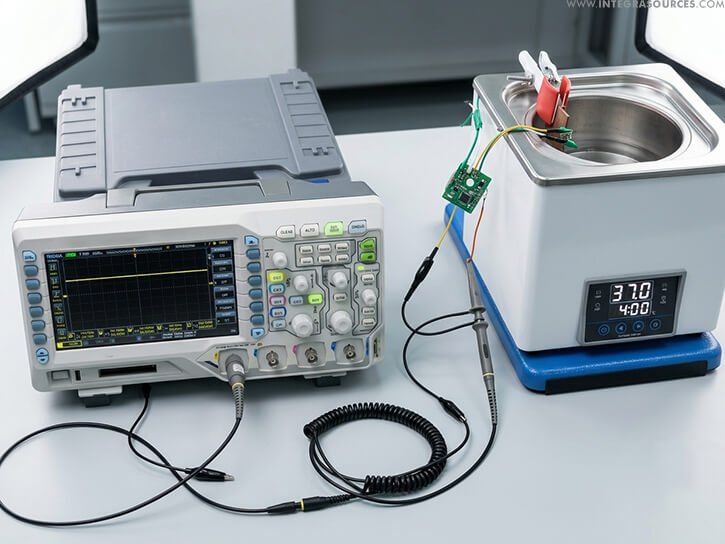
The chemical reaction measuring glucose levels produces an extremely small electrical current—just a few nanoamperes. Our engineers had to use circuits with transimpedance amplifiers to read such weak signals and filtering circuitry to isolate the useful signal from the noise.
Furthermore, we had to experiment with applying various polarization voltages to the electrochemical sensor to ensure it produces correct values that accurately reflect glucose levels. If the voltage is too low, the reaction will not trigger, resulting in no signal. If the voltage is too high, the readings become inaccurate.
Power Consumption
Continuous glucose monitoring systems impose strict power consumption requirements. The devices must maintain a shelf life of at least one year and operate for at least 14 days after activation. This demands optimization at both the hardware and software levels.
At the hardware level, the team added an extra load switch to the power supply circuit, physically disconnecting almost all electronics from the battery. This minimizes leakage currents in storage mode. Only the magnetic sensor remains powered, consuming around 20 nA.
At the software level, we reduced power consumption by regulating the radio transmitter power, optimizing data transmission and BLE connection intervals, and limiting the volume of transmitted data. The team also used the classic technique of putting the microcontroller and device peripherals into sleep mode between measurements.
Memory Constraints
Since mounting an external memory chip on such a tiny PCB was impossible, measurement logs had to be stored directly on the device, specifically in the microcontroller's internal flash memory. Flash memory has limited write endurance and a very constrained capacity. So it was critical to prevent frequent overwrites of the same memory sectors.
To solve this, we implemented a circular buffer for measurement storage in the internal flash with built-in wear leveling: data is written sequentially, and once the memory is full, new measurements begin overwriting the oldest records.
Scope of Work
- PCB design and testing.
- Embedded software development.
Technologies
- nRF52 in a BGA package with integrated NFC and BLE modules was used as the microcontroller of the device.
- The RR123-1H02-612 magnetic sensor was used as the activation sensor.
- Altium Designer was used for schematic design and PCB layout.
- The firmware was developed in С/С++ using NFC T2T/T4T and Nordic nRF5 SDK.
- LittleFS was used as the device’s file system.
Result
The project resulted in a production-ready continuous glucose monitoring system capable of competing with other products on the market.
Our participation made it possible to:
- Rework the client's prototype into a production-ready device and mitigate market launch risks.
- Reduce production costs and minimize device dimensions, bringing the product closer to its competitors in terms of both pricing and form factor.
- Improve measurement accuracy to meet industry standards by redesigning the signal amplification circuitry and optimizing the polarization voltage level.
The client is currently preparing the device for mass production and commercial launch.
PCB diameter
operation time after activation
shelf life in storage mode
You might also like...

Adapting U-Boot to Run a Custom Operating System on Rock Pi 4B+
Our team adapted U-Boot to run a custom operating system on the target hardware platform. We also prepared and delivered the infrastructure required for building the bootloader in-house. 
LEARN MORE 

Monitoring System for Office Plant Care
The system tracks soil moisture and other parameters and alerts users when watering is needed. The project included gateway design, as well as mobile and web applications development with Flutter.
LEARN MORE