


Project Development Specification: How To Write the Right One



- Why Do We Need a Specification?
- Can We Do It Without a Spec?
- How to Write a Spec
- Who Writes a Requirement Document?
- What Should Be Included in a Project Dev Specification?
- Terms, Abbreviations, and Definitions
- Product Summary
- Project Requirements
- What Is a Good Project Development Specification?
- Typical Mistakes in Specifications
- No glossary
- Unclear wording
- Missing Confidentiality and Data Security Requirements
- Mixing functional and non-functional requirements
- Compliance and Regulatory Oversight
- Conclusion
A robust technical specification document is the cornerstone of successful software and hardware development initiatives. Understanding what project specifications are and mastering how to write a tech spec can be the key difference between project success and costly setbacks. At Integra Sources, over 250 electronic design projects have benefited from our expertise. We turned initial concepts into fully operational solutions with the help of a well-crafted software development specification or hardware development specification, consistently reducing development time by 30–40% and preventing scope creep and misalignment between stakeholders.
In this article, we’ll share our expertise, walking you through the complete specification development process for software, hardware, and complex embedded systems — from requirements gathering to final documentation. In each section, you’ll find practical recommendations designed for reliable, business-focused results.
Why Do We Need a Specification?
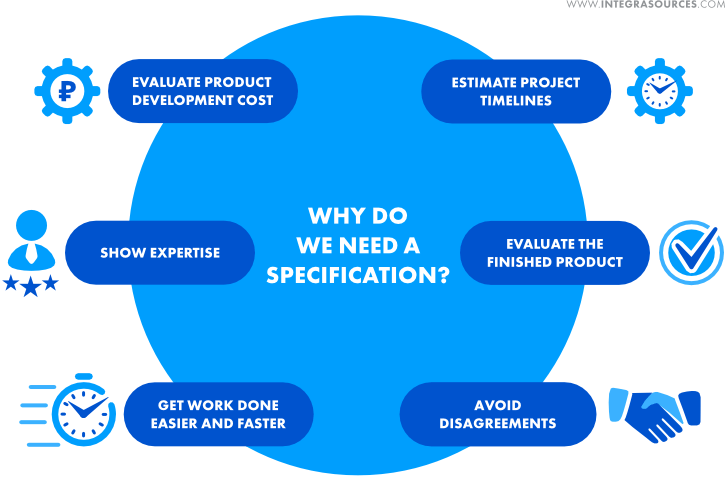
A requirement specification for hardware and software development is a document that defines the requirements for a tech product, including its purpose, functions, behavior, components, technologies, and development tools. A project dev specification serves as the guide for business and technical teams involved in a technological solution creation.
A clear technical specification document delivers measurable business benefits, such as:
- Lower development costs, through precise definition of requirements and deliverables.
- Reduced delivery timelines, ensuring accurate project estimates with only 10–15% deviation.
- Improved risk control and transparency, especially for stakeholder requirements analysis and project scope definition.
- Prevention of misunderstandings and unplanned changes through specification review process and requirements validation.
- Alignment of business and technical teams, enabling smoother project handoffs and continuity — even when teams change or projects pause.
- Clear evaluation of project deliverables by matching final outputs to documented criteria and expectations.
For both client and contractor, a high-quality technical specification document is essential at every stage, from planning to approval and acceptance.
Can We Do It Without a Spec?
Spec preparation requires time and expertise, and the costs are naturally high. Therefore, in an effort to save time and money, some customers may choose to prepare in-house specs or skip this step altogether.
We strongly recommend that any project, no matter the scale, should have a specification document — a paper listing requirements for the product, its components, and the future workflow. This paper may not be the technical specification document in the classical sense, but even a brief version would be a great help.
When contacting a custom software and hardware development company, you may write down your product vision and ideas in any form you like. Of course, it would be a big advantage if you have expertise in electronics design and programming, but for now, your goal is to describe your future product as clearly as possible.
Based on this description, your technology partner will create a full-fledged requirements specification that will serve as a guideline in subsequent development.
How to Write a Spec
The technical specification contains subject data and detailed descriptions of the development process. The more complex the project, the more specialists will be involved in writing the requirements specification, and the more information the final document will contain..
Who Writes a Requirement Document?

To create a good specification, you can’t just use any technical spec template that pops up in your Google search.
Technical specifications for device design and software development projects are written by qualified professionals who know all about the work stages, key components, technologies, and final product characteristics. PMs, development team, and testers contribute their expertise, building an overall project picture.
You can entrust the creation of technical specs to your in-house specialists who know exactly what kind of product you need and are capable of describing the desired functions and characteristics of the device or program in the document. But this often results in double work and a waste of time and money.
In contrast, when it’s your outsourcing company that is in charge of the requirements document creation, they take into account not only your wishes, but the contractor's technical capabilities, such as component-specific and language-specific expertise, development experience, etc.
In any case, every part of the technical spec must be talked through together and signed off by the client, so everyone can kick off knowing the final product is built to match what’s needed — no surprises, no missed details.
What Should Be Included in a Project Dev Specification?
Each specific project requires its unique technical specification. Nevertheless, all requirements specifications for software, hardware, and embedded system development will have some common sections.
Terms, Abbreviations, and Definitions
The terms used in the text are defined at the beginning of the document. These can include IT concepts: element names, development environments, programming languages, and technical definitions; as well as words and definitions related to its subject area or industry.
The more thoughtfully the glossary is put together, the easier it is for the contractor and the client to get on the same page.

Product Summary
This block describes the purpose of the IT solution, the reasons for its creation, and the target audience. Typically, businesses create IT products for the following reasons: increasing their client base, creating a positive image of the company, increasing labor productivity, or automating manual work.
This paragraph also contains project goals, for example, developing a turnkey solution, delivering a certain project stage (for example, creating software for a finished hardware platform), or improving an existing product.
Project goals must be specific and clear so that the proposed solution meets the performance metrics.
Project Requirements
The project requirements are the foundation of the technical specification document, and this part should contain the most detailed information. Typically, it contains the following subsections:
General requirements define the phases of the development process.
Here is an example of general requirements for developing a hardware and software system for equipment control.
Project stages:
- To develop a controller to manage client devices.
The controller must be installed on each device.
- To create a device control panel using a Linux-based single-board computer.
- To develop an application for remote control.
- To integrate the control panel and controller into a single system.
- To test the system.
- Subsequent system improvements and modifications.
Functional requirements refer to the IT solution's functions and behavior.
Example:
- The system should send notifications about equipment failures.
- The system must control the sensors.
- The system must transmit data over a radio channel.
- The system must have an alarm.
- The system must manage all the device functions.
Non-functional requirements define key considerations such as performance, scalability, maintainability, product security, and other criteria.
Requirements for the development process can be presented in several paragraphs and describe work stages, components, and software tools to be used.
For example, in a project dev specification for a software and hardware complex, you may need a paragraph describing the requirements for the device, communication protocols (MQTT, TCP, etc.), and a user application for managing the device.
The statement of organization and quality of work determines how to arrange everything related to the project: communication between the customer and the contractor, the main points regarding the quality of the system, device, or software product (continuous operation time, system behavior in an emergency, and so on).
Safety considerations may contain requirements for security protocols, code protection, access control, access rights, etc.
In addition to the main points, the spec contains blocks that are individual for each project, for example, roles for access control, user interface design requirements, and requirements for the device size and appearance.
What Is a Good Project Development Specification?
What should a quality specification for hardware and software development look like? How many pages do you need — one or fifty? Should you use formal language or technical slang? Do you need visual aids or not?
First, technical design specifications should be written in clear and simple language, so that it's digestible not only for technical specialists but also for sales managers and the customer's team. Of course, you can’t do without technical terms, but avoid overloading the text with them.
Schemes, drawings, and tables are not compulsory but highly desirable. Graphic elements convey information visually, which many find more comprehensible.
The spec size depends on the project's scale and complexity. The larger the project, the more preparatory documents are needed. The technical specification document for a battery management system, a project that will take several years, cannot be a one-page document.
However, you may want to look for a balance of conciseness, clarity, and technical details even when writing detailed technical specifications for large-scale projects.
What can happen if you don’t pay due attention to specification preparation and study? At the very least, it will cost additional time. At worst, it can cause disagreements between the parties and lead to a technical solution failing to meet the customer's requirements.
We faced such situations. A customer came up with an idea for a device. But some of its functions could not be implemented together. In the technical specification document, we described the only possible solution, but, unfortunately, the client didn’t pay attention to it. Needless to say, the result unpleasantly surprised him.
To avoid such consequences, the customer should devote time to study the specification: discuss technical aspects and delve into the finished engineering design document.
It is better to entrust the preparation of your technical design document to professionals — those who will be in charge of your technical solution creation. Don't worry if you lack understanding of the hardware or software development process; all you need to have is an idea.
A competent outsourcing team that deals with custom electronics design and software development can draw up a high-quality specification, discuss all the details with the customer, take into account all operational considerations, and select the most appropriate element base and software tools.
A good spec will save time, money, and nerves for both the client and the developer.
Typical Mistakes in Specifications
Crafting effective technical documentation for electronics design or IT infrastructure projects takes more than just listing requirements — it's about clarity, accuracy, and foresight. Here are some frequent pitfalls and modern missteps to watch out for:
No glossary
Professional terms left unexplained create confusion between contractors and clients. For example, unclear references to music services or sports leagues (NBA, MLB, etc.) should be grouped and defined clearly in the glossary to keep everyone on the same page.
Unclear wording
Vague phrases such as “the application should be fast” or “the system must efficiently handle a high number of user requests” leave performance characteristics undefined. This causes misunderstandings — developers might think “fast” means millisecond responses, while clients imagine handling thousands of simultaneous users.
Missing Confidentiality and Data Security Requirements
Modern technical specifications must include clear policies for how confidential data is handled, stored, and protected. Omitting data security leaves projects — which may include IT infrastructure, technical support, and software solutions — vulnerable to regulatory breaches and potential litigation.
Mixing functional and non-functional requirements
Functional specification tells "what" the system does, while non-functional requirements set expectations for "how well" it does it (performance, reliability, security). Mixing the two leads to deliverables that miss critical benchmarks or force last-minute redesigns.
Compliance and Regulatory Oversight
Specifications often skip “further considerations,” including compliance updates, accessibility standards, and liability details. Missing these in technical projects (especially medical or regulated industries) invites costly delays and redesigns.
Conclusion
When developing complex projects such as electronic devices, applications, embedded software, or IoT systems, the first thing you need to do is create technical specifications. A spec can be a short document or a lengthy detailed one depending on the project's scale and complexity.
A technical specification outlines the idea of the purpose and functions of the product, technical requirements, the stages actual implementation, and acceptance criteria for the completed solution.
The requirements document is the result of the teamwork of the project manager, technical leads, development team, testers, and, of course, the customer.
Writing technical specifications for a successful project is a complex process. It requires deep knowledge and expertise in software and hardware development. Professionals involved in creating a product technical specification should be able to navigate the electronic components market, evaluate logistics routes, perform cost benefit analysis and present information.
The most reasonable solution would be to entrust the technical specs preparation to the outsourcing development company. The crew will take into account its expertise and all your hardware and software requirements. In this case, the implementation phase will go faster and more comfortably for the project owner.
You can apply to Integra Sources with your idea, and we will help you create a unique application, electronic device, or software and hardware system of any complexity. We will prepare a concise and understandable requirements specification, which will serve as the basis for future project success evaluation.
Related
materials


Corporate Messenger Development
Integra Sources developed a corporate messenger for a large enterprise. The team created a client-server app, a Rest API, and...
LEARN MORE 
LEARN MORE

IT Project Discovery Phase: What's That, and What Does It Do?
The project Discovery Phase is aimed at helping you arrange a flawless development process that will provide you with suitable...
LEARN MORE
LEARN MORE
What Makes Electronics Prototyping so Important for Successful Product Development?
Electronics prototyping answers a range of crucial questions, such as how to solve a particular engineering problem, how to do...
LEARN MORE
LEARN MORE